Methane hydrate is also known as burnable or flammable ice
Japan says it has successfully extracted natural gas from frozen methane hydrate off its central coast, in a world first.
Methane hydrates, or clathrates, are a type of frozen "cage" of molecules of methane and water.
The gas field is about 50km away from Japan's main island, in the Nankai Trough.
Researchers say it could provide an alternative energy source for Japan which imports all its energy needs.
Other countries including Canada, the US and China have been looking into ways of exploiting methane hydrate deposits as well.
Pilot experiments in recent years, using methane hydrates
found under land ice, have shown that methane can be extracted from the
deposits.
Offshore deposits present a
potentially enormous source of methane but also some environmental
concern, because the underwater geology containing them is unstable in
many places.
"It is the world's first offshore experiment producing gas
from methane hydrate," an official from the economy, trade and industry
ministry told the AFP news agency.
A survey of the gas field is being run by state-owned Japan Oil, Gas and Metals National Corporation (JOGMEC).
Engineers used a depressurisation method that turns methane hydrate into methane gas.
Production tests are expected to continue for about two weeks.
Government officials have said that they aim to establish
methane hydrate production technologies for practical use within five
years.
A Japanese study estimated that at least 1.1tn cubic metres of methane hydrate exist in offshore deposits.
This is the equivalent of more than a decade of Japan's gas consumption.
Japan has few natural resources and the cost of importing
fuel has increased after a backlash against nuclear power following the
Fukushima nuclear disaster two years ago.
Methane clathrate - 'Fire ice'
Hydrates are a frozen mixture of water and gas, primarily methane
The methane molecules reside inside a water molecule lattice
The methane will ignite in ice form - hence the "fire ice" moniker
Clathrates tend to form under frigid temperatures and high pressures
They are found in ocean sediments and under the permafrost on land
Vast deposits are thought to exist, rivalling known reserves of traditional fossil fuels
Thousands of people per day are uploading videos of themselves dancing to the Harlem Shake
Reggae
artist Hector Delgado and rapper Jayson Musson say the producer of the
chart-topping hit Harlem Shake did not have permission to use their
voices.
The pair are now asking for compensation from record label Mad Decent Records, which released the single, reports the New York Times.
Harlem Shake has become an internet sensation on video website YouTube.
Producer Harry Rodrigues, also known as DJ Baauer, and Mad Decent Records declined to comment.
Musson told the New York Times the record label had been "more than co-operative" but an agreement had not yet been reached.
The song has inspired thousands of people around the world to
upload videos of themselves dancing along to the first 30 seconds of
the track - up to 4,000 a day are currently being put onto YouTube,
according to the website.
The song was initially released in 2012. Rights issues
Delgado can be heard at the beginning of the track singing, "Con los terroristas," a sample from a single he released in 2006.
Musson shouts, "Do the Harlem Shake," about 15 seconds in,
which he says is taken from a rap by his group Plastic Little in 2001.
In the New York Times, Delgado's agent, Javier Gomez,
described the situation as "a clear breaking of intellectual property
rights".
Last month in an "ask me anything" session on website Reddit, Rodrigues was asked about the origin of a female Spanish vocal that also features on the track.
"Found it on the innerweb," he wrote in reply.
Barney Hooper, from PRS for Music,
which represents the rights of music creators, told the BBC: "If one
piece of music is sampled in another, then typically the creators of the
original work would be entitled to a share of royalties when the new
work is played, performed or reproduced," he said.
"A song can have a number of songwriters/composers and use samples of other works.
"If this is the case, all could have an ownership share in
the new work and these would be registered with organisations like PRS
for Music.
"We then pay out the royalties we collect based on the ownership shares registered with us."
However the situation was sometimes complicated, Mr Hooper added.
"There are often ownership disputes relating to popular works where others musical works are sampled," he said.
By Amelia Butterly Newsbeat reporter Beyonce and Jay-Z, one of the richest couples in hip hop, have been targeted
US celebrities including Beyonce and Jay-Z have had private details of their finances posted online.
Hackers have also put up information, but not credit reports,
about US Vice-President Joe Biden and former Secretary of State Hillary
Clinton.
Los Angeles police say they are investigating how a police
chief's private details, including his address and a credit report,
ended up online.
Police Cmdr. Andrew Smith described the site as "creepy".
He said: "People get mad at us, go on the Internet and try to find information about us, and post it all on one site.
"The best word I can use to describe it is creepy."
He also confirmed that police would be investigating the posting of information about any celebrities living in Los Angeles. Britney Spears, Ashton Kutcher and Kim Kardashian are all said to be affected
Other affected people include Paris Hilton and Kim Kardashian.
Some of the private financial information posted includes
social security numbers, which could allow fraudsters to commit identity
theft.
Actors Mel Gibson and Ashton Kutcher are also reported to have been targeted on the site.
Information about FBI Director Robert Mueller is thought to
have been uploaded. The bureau says it is aware of the site but has not
revealed whether they will be investigating.
More names were added throughout Monday, including Britney Spears and former presidential candidate Sarah Palin. Former US Secretary of State Hillary Clinton is thought to have been hacked
The website uses an internet suffix assigned to the Soviet
Union and includes some unflattering pictures of the people who are
mentioned.
It did not state how it sourced the information but did include an anti-police message written in Russian.
One of the site's pages also made reference to the former
police officer Christopher Dorner who apparently committed suicide
during a large scale manhunt, after he killed four people.
So far representatives for each person targeted either
declined to comment on the accuracy of the information that was posted,
or they did not return messages seeking comment.
From BBC
Tuesday, March 12, 2013
Gerrard sets sights on top five
By ESPN staff
Liverpool captain Steven Gerrard says the club must deliver "the
perfect finish" to the season if they are to finish in the top five.
PA PhotosSteven Gerrard is looking for a strong finish to ensure the Reds play European football next season
The
Reds have not finished higher than sixth since 2008-09, but the new
owners have made clear that a return to the Champions League is a
priority. With Liverpool currently sixth, seven points behind
fourth-placed Chelsea and having played an extra game, it would appear
that they may have to wait a little longer to achieve that aim.
After
a run of three successive wins, though, Gerrard is hoping the Reds can
produce a strong finish to the campaign and, at the least, claim a place
in the Europa League by securing fifth.
"Liverpool don't
belong in seventh, eighth or ninth in the table," he said. "We want to
push for the European places year after year. Hopefully it's not too
late but we will need to produce the perfect finish to sneak in the back
door."
Liverpool are currently two points behind Arsenal,
who have a game in hand, and Gerrard added: "The top five places are the
target. Let's see what happens in other big games that are not in our
control. Hopefully the teams above us will slip up. All we can control
is our performances and our consistency and hopefully we will finish
strong."
Liverpool had been struggling to secure positive
results against teams in the top half this season, but they beat Swansea
last month and then, most impressively, beat third-placed Tottenham 3-2 on Sunday.
"I
think this season has been slightly strange in the way that usually we
do really well against the top sides and we slip up against the sides we
should be beating, but we have been putting those sides away quite
comfortably with three, four and five-nils and looking really good,"
Gerrard said. "We haven't got the points we've needed against the top
sides.
"This result and performance (against Spurs) will
give us great confidence and belief. Hopefully it will be a springboard
for us to go on and finish the season really strongly.
"At
times we haven't got what we've deserved against top sides but we can't
look for excuses. We are where we are and we need to take responsibility
for where we are in the league.'' Information from the Press Association was used in this report
North Korean rhetoric has left the South, with whom it remains at war, on alert
South
Korea says North Korea cannot scrap the armistice that ended the Korean
War and called on Pyongyang to tone down its rhetoric.
A unilateral move to end the pact was not legally possible, it said.
As well as the armistice threat North Korea has in recent
days also cut off a hotline and vowed to end non-aggressions pacts with
Seoul.
It says it is responding to US-South Korea military drills and new sanctions imposed after its third nuclear test.
The two Koreas remain technically at war because the 1950-53 conflict ended in an armistice, not a treaty.
North Korea has declared that armistice "invalid", but South Korea said a one-sided declaration was insufficient.
"Unilateral abrogation or termination of the armistice
agreement is not allowed under its regulations or according to
international law," Foreign Ministry spokesman Cho Tai-Young said.
Seoul would "absolutely keep the armistice agreement as well
as strengthen consultation and cooperation with the United States and
China, who are also concerned parties of the armistice", he said.
"We demand North Korea withdraw remarks threatening stability
and peace on the Korean peninsula and in the region," the spokesman
added.
This is not the first time North Korea has said it was
withdrawing from the armistice. It also issued a similar threat after
its nuclear test in 2009, for example. "Bellicose rhetoric"
In recent weeks, however, there has been a marked escalation
in rhetoric from Pyongyang, following international condemnation of its
nuclear test.
It opposes the fresh UN sanctions and has also voiced bitter
opposition to two annual joint US-South Korea military exercises that
are currently under way.
North Korea looks set to conduct military exercises in coming days, South Korea says
State-run television showed footage on Monday of mass rallies
across the country to denounce the US and South Korea, while the state
news agency also described leader Kim Jong-un briefing troops at a
military unit near a border island.
He told local commanders on Baengnyeong Island - close to the
disputed inter-Korean maritime border and the site of the 2010 sinking
of a South Korean warship, the Cheonan - to conduct "merciless firepower
strikes" if provoked, KCNA said.
Late last week he gave similar instructions to troops near
Yeonpyeong Island, the scene of shelling in November 2011 that left four
South Koreans dead, KCNA said.
White House spokesman Jay Carney said the US was "certainly concerned by North Korea's bellicose rhetoric".
"The threats that they have been making follow a pattern designed to raise tension and intimidate others," he said.
On Monday the US imposed additional sanctions on North Korea. The US Treasury added the
Foreign Trade Bank (FTB) of North Korea and Paek Se-bong, the chairman
of a committee which it said oversaw production of ballistic missiles,
to the sanctions list. The US State Department also added three North Korean officials it said had links to the communist country's proliferation activities.
The sanctions ban any US individual or entity from transactions with those named.
In a speech, US National Security Advisor Tom Donilon said
North Korea should "change course" to obtain the aid and respect it
sought.
"North Korea's claims may be hyperbolic, but as to the policy
of the United States, there should be no doubt: We will draw upon the
full range of our capabilities to protect against, and to respond to,
the threat posed to us and to our allies by North Korea."
A spokesman for South Korean President Park Geun-hye,
meanwhile, has said that her first overseas trip since taking office
will be to the US in May, taking into account "the recent Korean
Peninsula situation".
North Korea's third nuclear test followed an apparently
successful launch in December of a three-stage rocket, seen as a banned
test of missile technology.
Regional neighbours and the US fear Pyongyang is working to
build a nuclear warhead small enough to put on a missile, but believe it
does not yet have the capabilities to do so.
The cardinals have been seeking divine guidance for the choice ahead
Cardinals
gathered in Rome to elect the new Pope will begin voting later, with no
clear frontrunner to take over as head of the Roman Catholic Church.
The 115 cardinal-electors are attending a special Mass in St
Peter's Basilica before processing into the Sistine Chapel to begin
their secret deliberations this afternoon.
They will vote four times daily until two-thirds can agree on a candidate.
The election was prompted by the surprise abdication of Benedict XVI.
The 85-year-old stepped down last month saying he was no
longer strong enough to lead the church, which is beset by problems
ranging from a worldwide scandal over sexual abuse to allegations of
intrigue and corruption at the Vatican bank.
Benedict's resignation and the recent damage to the Church's
reputation make the choice of the cardinal-electors especially hard to
predict, the BBC's James Robbins in Rome says.
They will weigh pressure for a powerful manager to reform the
Vatican against calls for a new Pope able to inspire the faithful, our
correspondent adds.
At Tuesday morning's "Mass for the Election of the Supreme
Pontiff" in St Peter's Basilica the cardinals are seeking divine
guidance for the election ahead.
Conclave interactive video
Step inside our virtual Sistine Chapel as Philippa Thomas explains the process to elect a new Pope
In his homily, the Dean of the
College of Cardinals, Cardinal Angelo Sodano praised the "brilliant
pontificate" of Pope Benedict and implored God to grant another "Good
Shepherd" to lead the church.
He outlined the mission Catholics believe was given by Jesus
Christ to St Peter - the first Pope - emphasising love and sacrifice,
evangelization and the unity of the church.
The BBC's Michael Hirst in Rome says the speech was more
measured in tone than the address given in 2005 by Cardinal Joseph
Ratzinger before he became Pope Benedict, which featured a fiery attack
on the "dictatorship of relativism".
By ESPN Staff
Liverpool midfielder Lucas Leiva says the recent Tottenham victory
has allowed the Anfield club to start dreaming of a Champions League
berth.
PA PhotosLucas Leiva is dreaming of the European Champions League
The 3-2
come-back victory moves the Merseysiders up into sixth position on the
Premier League table, seven points adrift of the race for a spot in
Europe's elite competition.
"We are improving at the right time and, because of that, we can dream of a Champions League place," Lucas said.
"Our
greatest virtue in this match was that we never stopped fighting. We
didn't get upset at losing and showed our strength to comeback.
Liverpool are one of the form teams in the league right now, the Tottenham victory making it three wins in a row for the club.
And
despite admitting the club was proud of its recent record, Lucas said
he and his team-mates are focused on stretching their winning form even
further.
"It was our third consecutive victory, something that is worth a lot given the difficulty of the Premier League," he said
"We will continue to work hard, without fanfare, and things will come naturally."
SEATTLE -- Nigerian forward Obafemi Martins says on Twitter he is leaving Spanish club Levante to join the Seattle Sounders.
Martins
made his posts on Monday, which was followed by an announcement from
Levante that he was leaving. Martins wrote that he wanted to give thanks
to Levante for the chance to play in La Liga, but that signing with
Seattle is, "a big step to take in my career."
At training on
Monday, Seattle general manager Adrian Hanauer told reporters there was
nothing official to announce but did not deny "indicators" that pointed
to Martins playing for Seattle in the near future.
The Sounders have been seeking a replacement at forward to play alongside Eddie Johnson since Fredy Montero
was loaned to Colombian club Millonarios. The 28-year-old Martins had
nine goals in 22 matches in all competitions for Levante this season.
His best seasons were with Inter Milan (2001-06) and Newcastle (2006-09).
It
is the curse of the modern age. After a day spent text messaging,
emailing and browsing the web, your smartphone is dead. So now, after
brushing your teeth and letting the dog out, there is another task:
plugging in your phone.
But it never used to be like this. Simple
handsets used to keep on going for days on end. So what changed? And
more importantly, what is the mobile industry doing about it?
The
big difference is of course the technology -we used to talk on 2G
phones that ran on the old GSM networks. They could last for almost a
week, partly because we asked so little of them. As detailed in the previous article in this series,
smartphones became powerful computers because they needed to be to make
strong, wireless connections to the network. And when they make those
connections we ask them to do data-intensive tasks like stream video.
Every
single step along the way involves information processing. That takes
currents flowing around silicon chips; and currents running round
silicon chips generate heat, wasting energy. PC and laptop users are
constantly reminded about this by the whirr of the fans that keep their
processors cool. We don't notice it on phones, because everything they
do seems to happen so silently, so effortlessly. But when you look at
the detail, energy drips way like water from a leaky tap. And it all
adds up.
Take the work of Dr Angela Nicoara, senior research
scientist at the Deutsche Telekom Innovation Center in Silicon Valley.
She has become something of a digital dietician, counting the joules
that go into feeding our smartphones' appetites. She recently laid out
her findings in a report she enticingly called Who Killed My Battery?
In
a collaboration with the group of Professor Dan Boneh at Stanford
University, she connected a state of the art electronic meter to the
battery of a smartphone, which typically store around 15-20,000 joules
of energy, and then tracked the power for every millisecond it performed
one of the most common applications for our handhelds: browsing the
web.
What emerged when she broke down the actions millisecond by millisecond came as a surprise.
The
first was that just hitting the “go” button and getting the phone to
contact the network used 12 joules, as the phone exchanged details with
the local base station, agreed transmission settings and so on. That’s
before a single byte was downloaded. When that process begins, the real
surprises come thick and fast.
It turns out that the design of the
web page has a massive impact on the energy it takes to put it on your
mobile screen. For example, the BBC News website, specifically designed
for mobile users, took another 3 joules to download and process all the
bits for a news story. For the worst performer of the websites she
explored, Apple.com, it took another 34 joules – 11 times more than the
BBC. Wikipedia came just behind.
Careless websites, she found, are
at least contributors to killing her battery. For our PCs and laptops
connected to the mains, these numbers don’t matter. With the constraints
of a mobile battery they are critical.
The difference between
these websites was in the way that they were built. For example,
interactive elements that are used to customise a site experience and
often run in the background of a site were a big drain. A half of those
34 joules needed to see the Apple page were down to these functions,
without them even being touched; on Wikipedia, they alone cost 10
joules.
Another
drain are the so-called CSS files that tell a browser how to layout the
page. Again, on the Apple site, these required 12 joules to download
and render onto the screen. Simple improvements reduce this by 5 joules.
Each
joule might seem a trivial amount, but like a slimmer on a diet lots of
small savings soon add up – especially when some websites take eleven
times as much energy to visit as others. Electronic warfare
But
website design is not the only drain on a phone’s batteries. The way we
access these websites – and in particular the settings our service
providers use - also has a huge effect, according to Hari Balakrishnan,
Fujitsu Professor of Computer Science at the Massachusetts Institute of
Technology (MIT).
Surprisingly, it is the network that decides
what power setting our handsets use. When we need to transmit, the
network tells our handsets to power up to maximum. But the network’s
interests are different from ours. We would like to power down again as
soon possible to save our battery.
But only a slender portion of
an already crowded radio spectrum is assigned for these so-called
control messages, says Dr Balakrishnan. Because of that, the network
tries to minimise the number of control signals it sends, even if that
leaves our handset powering away while doing nothing.
“A classic
example,” says Dr Balakrishnan, “is when you’re running an application
that wakes up every 20 or 30 seconds and sends one byte of information.
That would, in many cases, keep your radio in the high-power, active
mode all the time. But it doesn’t have to. That kind of trivial workload
should consume next to no energy, but ends up using huge amounts of
energy because of the sub-optimal controls implemented by the networks.”
Like
Dr Nicoara, Dr Balakrishnan decided to test his suspicion by wiring his
battery to a meter and watching the battery drain. The results showed
that by letting the phone control its own settings, he could halve the
power consumed by the wireless transmissions with minimal effect on the
network performance (although he stresses the details change from device
to device, and from network to network).
Again, these might seem
small improvements overall – but a network that can give our phones a
few more hours of working battery life is highly likely to attract more
customers these days.
Of course, it wouldn't matter how long your
phone was fired up to exchange bits with the base station, if it could
do so with minimal energy. But it turns out the mobile industry has been
fighting a war with its electronics for years because they are so
inefficient.
Specifically, it is the purity of the radio wave that they use to connect to the base station that requires so much power.
With radio spectrum restricted (see the two previousarticles
in this series) transmission frequencies are squeezed in close
together, and any distortion in the signal would lead to catastrophic
interference. And it turns out that the basic physics of the amplifiers
that drive the antennae can only generate those pure waves when drawing a
lot of electrical current.
When the 3G standards were introduced,
manufacturers turned to a special design of amplifier first concocted
back in the 1930s, because of the stringent demands of the networks. But
even then, for every watt of transmitted radio power, there's more than
another watt simply warming your handset to create this pure wave.
Basically, simple physics is doubling the drain rate on your battery.
“The
industry is racing furiously to mitigate this problem,” says Joel
Dawson, Professor of Power Engineering at MIT, who has himself come
forward with a smart fix that involves electronically compensating for
this distortion, something that could apparently halve the losses. But
how soon any of those fixes will make it to the market remains to be
seen. Energy harvest
Of course these aren’t the only
drains on a battery. Modern smartphones pack everything from small
accelerometers to energy hungry global positioning systems. And then
there is the display - the whole selling point of the smart phone is the
interface that lets you access the world wherever you are. Until
researchers can develop electronic-inks similar to these used in the
Kindle e-book or other pixelated passive systems that refresh as fast as
lit screens, simply viewing the phone comes at a substantial cost.
The
obvious solution would be to pack in a bigger battery, but of all the
components in your handset, the battery is the one that represents
seriously mature technology. Most of the electrochemistry was laid down a
hundred years ago and, as one battery manufacturer confessed to me,
there's little they can do about. The introduction of the rechargeable
lithium-ion battery in the 1990s was something of a step change. But
since then … well, while virtually every other phone parameter doubles
in a year or two, it takes a decade to double battery performance.
There are ongoing efforts to improve battery technology (See: Charging Tomorrow’s smartphones) but there may also be another route: harvesting energy from the environment.
Solar
power is long-established, and has been tried many times with mobile
phones, but has failed largely because of inconvenience. As the front of
phones is crowded out with buttons, photovoltaic cells have largely
been put on the back – but that has required turning a phone upside down
to keep the battery charged.
But the form of the modern smart
phone, freeing up the top face, has changed all that. And one potential
solution is on display at this week’s Mobile World Congress in Barcelona
this.
WYSIPS (“What You See is the Photovoltaic Surface”), as it
is known, is a joke, according to Francis Robcis, sales director for the
new product. “Because you can’t see it,” he explains.
And it needs to be like that, because WYSIPS has silicon solar cells embedded within the large smartphone display.
“Go
into the office, and most people will leave their phones lying around
with the face up,” says Robcis. So that when the set is idle, the tiny
silicon strips (too small to see) are busy recharging the battery.
The
challenge has been to integrate the photovoltaics into the display
without dimming the image by more than 10 per cent – a reduction users
should find acceptable. And to allow it to sit alongside the touchscreen
function. If the system takes off, the future mobile screen could
become a busy place.
The company hopes to have a pilot line producing screens by the end of the year, to prove the technology is viable.
Powering
by sunlight, of course, is conventional, even if unfamiliar in mobile
phones. At the University of Washington Seattle, ex-Intel researcher
Joshua Smith is planning something much more radical: powering mobile
phones - with gratifying circularity - by radio waves.
His lab,
funded by tech giants Intel and Google, has already made great strides.
“The largest TV towers in the US put out around a megawatt of energy,”
Smith explains. “We’re able to operate our energy harvester as much as
30 km from one and get small but usable amounts of energy.”
In
essence, harvesting radio energy requires rewiring the phone antenna to
extract not the signal but the power of the carrier wave. And it’s not
only powerful TV transmissions that you can tap into. Recently, Smith’s
lab has been able to harvest energy from mobile phone masts.
The
quantities available are down in the microwatt range, so not enough to
power voice transmissions. But enough energy can be accumulated, Smith
says, to send short texts, or just to stretch the battery life.
“It
would be enough to have perpetual standby. My favourite example is
driving along in my car. My son is playing Angry Birds on the cell
phone, and completely drains the battery. And then I get a flat tyre. It
would be nice if I could send an emergency SMS using this ambient
energy. And of course, compared to solar power, you could even do it at
night.”
All of which means that the daily ritual of recharging your phone could soon be a thing of the past.
Mr Chavez's mother and brothers were among those who paid their respects
The body of Venezuelan President Hugo Chavez is lying in state at the military academy in Caracas.
His family and close advisers, as well as the presidents of
Argentina, Bolivia and Uruguay, paid their respects next to his open
coffin on Wednesday.
Mr Chavez died aged 58 after suffering from cancer for nearly two years.
Hundreds of thousands of people earlier took to the streets
of the capital to pay tribute as a hearse carrying his coffin took hours
to reach the academy.
The state funeral for Mr Chavez is due to take place on Friday.
The head of the presidential guard was quoted by the
Associated Press news agency as saying that he had been with Mr Chavez
when he died.
General Jose Ornella said Mr Chavez had died of a massive
heart attack, and in his final moments had said he wanted to carry on
living.
"He couldn't speak but he said it with his lips: 'I don't
want to die. Please don't let me die,'" said Gen Ornella, according to
AP.
A clear view of the Sun was not necessary for Vikings to navigate, scientists believe
A crystal found in a
shipwreck could be similar to a sunstone - a mythical navigational aid
said to have been used by Viking mariners, scientists believe.
The team from France say the transparent crystal may have been used to locate the Sun even on cloudy days.
This could help to explain how the Vikings were able to
navigate across large tracts of the sea - well before the invention of
the magnetic compass.
However, a number of academics treat the sunstone theory with scepticism. Viking legends
The team from the University of Rennes in France say they
found the crystal while examining the wreck of a British ship sunk off
the island of Alderney - in the English Channel - in 1592.
An oblong crystal the size of a cigarette packet was next to a
pair of dividers - suggesting it was part of the navigational
equipment.
It has now been shown that it is of Iceland spar - a form of
calcite known for its property of diffracting light into two separate
rays.
Testing a similar crystal, the scientists proved that by
rotation it was possible to find the point where the two beams converge -
indicating the direction of the Sun.
They say it works on cloudy days, and when the Sun has set.
This particular piece of Iceland spar was found on the
British vessel long after the Viking heyday in the ninth and 10th
Centuries.
But the scientists conjecture that use of sunstones may have
persisted for many centuries as a back-up to the often unreliable
magnetic compass, which was introduced in Europe in the 13th Century.
There is only a sketchy reference in the old Viking legends to the sunstone.
Vikings were seafarers from Scandinavia who used their
longboats to explore and conquer parts of Europe, Greenland, Iceland,
Russia and North America.
From BBC
Hugo
Chavez is the latest outspoken critic of the US to leave the world
stage. Is the era of the anti-American bogeymen at an end?
He floridly lambasted "imperial" American policies, compared
George W Bush to Hitler and even warned that exporting Halloween to
Latin America amounted to "terrorism".
But now Venezuelan President Hugo Chavez - variously
portrayed as a six-times elected champion of the people or a
constitution-fiddling demagogue - is dead.
His is not the only voice vociferously opposing the US to have fallen silent.
Recent years have seen the most prominent critics of American power exit the spotlight.
Fidel Castro - who outlasted nine US presidents -
relinquished his position as Cuba's president and Washington's
irritant-in-chief in 2008.
Osama Bin Laden, arguably the the most potent US bogeyman of all, was killed by US forces.
Axis of Evil
Initially described as Iran, Iraq and North Korea by George W Bush during his State of the Union address on 29 January 2002
In May 2002, Bush's Under-secretary of State John Bolton gave a speech entitled "Beyond the Axis of Evil" in which he added Cuba, Libya and Syria to the list
In 2005, Secretary of State, Condoleezza Rice said Cuba, Belarus, Burma and Zimbabwe were also "Outposts of Tyranny"
Saddam Hussein was toppled. Muammar Gaddafi was overthrown. Kim Jong-il succumbed to old age.
Even Iranian President Mahmoud Ahmadinejad - whose suspected
nuclear weapons programme strikes panic in Washington - is due to hand
over power in 2013, as he is limited to two terms of office.
These men may have represented a wide range of political
ideologies, from socialism to secular Arab nationalism to Islamic
fundamentalism.
But all were, in their own ways, icons of a tendency commonly referred to as "anti-Americanism".
The label "anti-American", though, divides opinion.
"Yesterday the Devil came here. Right here. And it smells of sulphur still today”
Hugo ChavezUN General Assembly, 2006
President George W Bush - who
famously referred to Iran, Iraq and North Korea as the "axis of evil" in
his 2002 State of the Union speech - saw anti-Americanism as a visceral
opposition to what America stands for. America's enemies "hate our
freedoms", as he put it.
But Max Paul Friedman, history professor at American
University, dismisses it as "a term that's been used to characterise
almost any disagreement with US policy of the day".
America's bogeymen have tended to be cast as "not only
undemocratic, but also fierce defenders of their own nationalist
narratives", he says. At the same time, he notes the "anti-American"
label was widely applied to liberal democracies such as France when they
opposed the war in Iraq.
Where Chavez belonged on this spectrum was, of course, hotly debated.
Russell Berman of Stanford University, meanwhile, says it is
possible to "distinguish between the visceral anti-Americanism of
explicit stereotypes and criticism that may be legitimate".
He argues that in much of the Arab world a "combination of
anti-Semitism and anti-Americanism" is open to exploitation by populist
leaders, and points to the killing of US Ambassador Christopher Stephens
in Benghazi, Libya in 2012 as one tragic outcome.
Anti-US feelings remain strong in much of the Muslim world
It's not immediately clear where the next generation of
bogeymen will come from to take Chavez's place alongside Kim Jong-un and
whoever is elected to replace Ahmadinejad.
"On use of military force, religion, and individualism, Americans and Europeans continue to disagree”
Pew ResearchGlobal Attitudes Project
The Arab Spring has left few leaders with the popular authority to act like traditional demagogues.
Cuba's communist regime remains intact, but under the
presidency of Fidel Castro's brother Raul - a dour figure less given to
incendiary rhetoric, who has announced he will retire in 2018.
Latin America has plenty of leaders still prepared to
challenge US interests - Bolivia's Evo Morales, Nicaragua's Daniel
Ortega and Ecuador's Rafael Correa, for instance.
But none display quite the pantomime flamboyance of Chavez,
who once told a UN General Assembly that George Bush was "the devil
himself" and that he had left a "smell of sulphur" in the Assembly
chamber.
Even the low-level anti-Americanism detected by US leaders
among opponents of the Iraq war in Western Europe - "old" Europe in
Donald Rumsfeld's phrase - is in full retreat.
Obama's election in 2008 coincided with a change in attitudes towards the US
A Pew survey released in December 2012
found support for the US had soared in Europe following Barack Obama's
election as president - even though a significant "values gap" remained
over attitudes towards cultural and religious issues.
Psy apologised for his attack on "Yankees"
Bush's "cowboy demeanour" made it easier to meld distaste for
American culture and society with opposition to US foreign policy, says
Brendon O'Connor of the University of Sydney and author of The Rise of
Anti-Americanism.
Oddly, the most recent international figure to have been
accused of anti-Americanism is the South Korean pop star Psy, best known
for his global hit Gangnam Style.
The rapper apologised after it emerged that in 2004 he had
performed a song that described killing "Yankees" who had tortured Iraqi
prisoners and killing their families "slowly and painfully".
This may have been going too far even for Hugo Chavez.
From BBC
The BBC's James Copnall reports from Nairobi where he says the allegations are "strong" but "relatively wooly"
The ballot count in Kenya's presidential elections has been rigged,
says Kalonzo Musyoka, the running mate of Prime Minister Raila Odinga.
"We have evidence the results we have received have been doctored," he said.
He said the vote count should be stopped but added that his comments were not a call for protest.
Mr Odinga has been trailing behind his rival, Uhuru Kenyatta.
There have been severe delays in counting as the electronic system has
crashed.
The head of the electoral commission has warned it may be
Friday or even Monday before there is an official result, the BBC's
Gabriel Gatehouse reports from the Kenyan capital, Nairobi.
The credibility of the count is crucial to avoiding further bloodshed, our correspondent says.
More than 1,000 people were killed in the violence which
broke out in 2007-08 after Mr Odinga claimed he had been cheated of
victory by supporters of President Mwai Kibaki, who is stepping down
after two terms in office.
Raila Odinga vs Uhuru Kenyatta
Uhuru Kenyatta
Son of Kenya's first President Jomo Kenyatta
Due to stand trial at ICC in April accused of organising violence in last election
His running mate, William Ruto, also accused
Both deny the charges
From Kikuyu ethnic group - Kenya's largest at 22% of population and powerful economically
Kikuyus and Ruto's Kalenjin community saw fierce clashes after 2007 poll
Currently deputy prime minister
Raila Odinga
Son of first Vice-President Jaramogi Oginga Odinga
Distant relative of Barack Obama
Believes he was cheated of victory in last election
From Luo community in western Kenya - 11% of population.
Some Luos feel they have been marginalised by central government
Third time running for president
Currently prime minister under power-sharing deal to end violence last time
Mr Kenyatta, who backed Mr
Kibaki, is due to stand trial at the International Criminal Court (ICC)
next month, accused of organising attacks on members of ethnic groups
seen as supporters of Mr Odinga. He denies the charges.
Fall in rejected ballots
"We as a coalition take the position the national
vote-tallying process lacks integrity and has to be stopped and
re-started using primary documents from the polling stations," Mr
Musyoka said on Thursday.
"It is not a call to mass action. We are committed as a coalition to the principle of the rule of law."
Following glitches with hi-tech voting and counting systems
earlier this week, the vote-tallying process was started again from
scratch, and by hand, on Wednesday.
Results were only being announced after the ballots had been
physically delivered to election headquarters in the capital, rather
than being filed electronically.
The latest figures indicate Mr Kenyatta has maintained his
lead over Mr Odinga, with 2.5m (53%) votes to 1.9m (42%) - as originally
indicated.
However, the new figures show that the number of rejected ballots, which has been a major issue, has sharply come down.
In the initial count, some 300,000 votes - about 6% - were disqualified for various reasons.
This figure has now come down to about 40,000. While the
reason for the drop remains unclear, some observers said that election
officials were being too strict first time round.
Mr Kenyatta's camp had rejected calls for some of these ballots to be included, as requested by Mr Odinga's allies.
The winning candidate must get more than 50% of the total
votes cast and at least 25% of votes in half of the 47 counties - the
latter was a requirement introduced in the new constitution to make sure
the new president wins with wide support rather than only with the
backing of voters in his regional and ethnic strongholds.
If there is no clear winner, a second round of voting will take place, probably on 11 April. From BBC
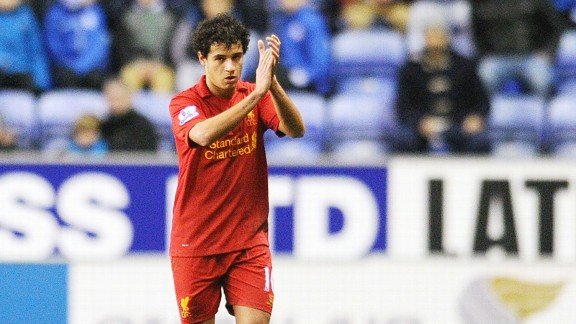
Andrew Powell/Liverpool FC/Getty ImagesNew arrival Philippe Coutinho has settled in nicely at Liverpool and is helping the Reds solve their attacking conundrum.
Football
is often a game of untruths. The best team does not always win the
league, for injuries, suspensions and luck are rarely accounted for.
Football is not necessarily a funny old game, especially when compared
to lacrosse. A ball can never be hit too well, no team is too good to go
down and San Marino would suggest there certainly are easy games in
international football.
At the DW Stadium on Saturday, another untruth was lampooned by two
players with three touches of a football. Philippe Coutinho flicked his
head up and instantly saw the run of Luis Suarez ahead. Pass, touch,
goal. In a game of such mercilessness from Liverpool, this was the
perfect goal to epitomise it all, carried out by two players who make
football seem so easy.
And to think it has been said there isn't value in the January transfer window.
It is far too early to herald the 20-year-old Brazilian a success,
of course, after a mere handful of appearances since his January move
from Internazionale. He impressed against Swansea and had the
man-of-the-match award against Wigan pickpocketed from him by Suarez's
sublime intervention, but Anfield has witnessed this all before.
Expectation and pressure are never kind welcoming gifts to young
players, particularly those adapting to a new culture both on and off
the field. The hope is those guilty will learn. They never do.
In fairness, Coutinho is someone to get excited about: The
nationality, the name, the curly velvet on his head. There is also the
relationship he's already struck with Suarez -- a player who can,
unconditionally, be labelled a January transfer success. With each
passing game, with each trick or flick that prompts a disbelieving
shriek of child-like glee, the 22.7 million pounds paid to Ajax seems
another million too short.
Ignoring the renaissance of Stewart Downing -- something many will
be keen to do having written him off so strongly in his 18-month
Liverpool career -- the front three of Suarez, Coutinho and Daniel
Sturridge is a full rebuttal to those who claim January is the
footballing equivalent to vultures swooping for scraps on a vast, barren
desert.
Liverpool have historically worked the January market well anyway,
mind-bending, face-melting panic buy of Andy Carroll aside. Daniel
Agger, Martin Skrtel and Alvaro Arbeloa have all performed for the club
at the highest level, while Maxi Rodriguez's arrival in 2010 was
ultimately as well-timed as his surges to the far post. January 2005
brought Fernando Morientes; a year later, Robbie Fowler brought closure
on his Anfield career.
But there was never as much pressure for the club to perform in
January as there was this year. For a club that has not performed well
under pressure in recent years, and a manager inexperienced in dealing
with such burden, that's quite the weight to contend with.
After a summer which prioritised yet more bloodletting of
Liverpool's squad, and a concerted effort to rid extortionate wages from
the club's payroll, the squad was so stretched it was almost
see-through. Slapstick attempts to lowball Fulham over Clint Dempsey saw
the American move to Tottenham, making this squad one strapped to a
torture rack of administrative ineptitude, each game another agonising
turn of the wheel. It barely survived four months; another five would
surely see it snap.
The younger members of the squad also had their elasticity tested.
With a lack of options from the first team available, Brendan Rodgers
called upon Raheem Sterling, Suso and Andre Wisdom. All three impressed
to begin with; all three, by November, looked like players who had been
used far too much, far too early. They were.
The problems were not just physical, but mental. Once the carrot has
been snatched and gnawed at from such a young age, motivation becomes
difficult. Sterling not only became weary from playing so much football
but from an on-going contract situation; for Suso, overconfidence and
motivation after was a far bigger opponent than most Premier League
defenders.
How quirky fate can prove; how things can work out for the best. Few at Liverpool would have thought so at the time.
Dempsey has been quiet at White Hart Lane, though the spotlight
naturally gravitates towards Gareth Bale regardless. The money saved
from that deal helped fund the signing of Sturridge early in January.
His arrival relieved the burden upon Suarez; the later addition of
Coutinho felt a luxury, an adornment to what has started to look a
fearsome front line.
Clive Brunskill/Getty Images.The January additions have given Brendan Rodgers a chance to rest key players.
Their
arrival has had an effect throughout the squad since January departed.
Not only does the pair provide genuine quality, but their presence
simply makes the squad bigger and gives Rodgers far more options to
choose from.
It also allows him to give those needing a rest ample opportunity to
have it. In the club's under-21 fixture against Manchester United on
February 26, Wisdom, Suso and Sterling all started; the efforts to dim
the dizzying, glaring limelight shone upon them have been necessary and
welcome. Earlier in the season, Sterling missed just 30 minutes of
league football in 16 games. Since the turn of the year, he's played
just 170 minutes in the league. Suso last appeared against Sunderland on
January 2, while Wisdom has not been seen since the 2-2 draw with
Arsenal in January.
All of this cannot be laid at the feet of Sturridge and Coutinho, of
course. The re-emergence of three players written off by many --
including the manager -- has swelled the squad. Downing, Jordan
Henderson and Jose Enrique are three players growing increasingly
comfortable with what is expected of them, and now appear three players
capable of being called upon.
With the squad originally so small at the start of the season, the
feeling was that somebody, anybody, in January would have done for
Liverpool. That Sturridge is a goal-scorer who possesses pace and
strength is a bonus for the squad; so too that Coutinho appears to be a
mercurial talent -- no bad thing given the meagreness of excitement in
that position over the years.
There is a growing feeling the attacking conundrum has finally been
solved with these two signings. That this season would become their best
goal-scoring season since 1996-97 after 28 games seemed a prediction
worthy of a sectioning after that arid afternoon against Arsenal, a day
after the morale-sapping transfer window slammed shut on Liverpool's
fingers.
Too often poor seasons are filed under ones of transition. Such
judgments should not be cast towards Liverpool and Rodgers until the end
of the season, at least. But that three talented young players in
Sterling, Suso and Wisdom have been integrated into the squad and now
have motivation to stay there is a surprise, welcome titivation to the
season.
The next step for Liverpool is to replicate January's business in
the summer. This time, it will be the defensive positions that require
scrutiny. But for now, while the brute of injury keeps quiet,
Liverpool's squad seems in a favourable position for the first time in a
long while.
Some will say this has all proven a bit fortuitous for Liverpool,
others will say this is a by-product of learning from mistakes.
Liverpool have a chance to prove it was judgment, rather than luck, this
summer.
That is something they must do properly if they want to continue
their goal of Champions League football within the next few seasons.
Joe Cole admits his decision to join Liverpool in 2010 was a mistake,
claiming his only other option was an unthinkable move to Tottenham.
GettyImages Joe Cole never found his feet at Liverpool
Cole,
31, spent two-and-a-half years as a player at Anfield but failed to
become a regular in the first team, being sent out on loan to Lille last
season before rejoining his boyhood club West Ham in January.
The
England international says he never felt comfortable at Livepool but
was forced to take up the only offer that appealed to him.
"I
can only play for teams that I'm passionate about and I think that's
what went wrong for me at Liverpool," Cole said. "I didn't feel a
connection with the club or the place that I had at Chelsea and West
Ham.
"I had seven great years at Chelsea but the club
wanted to go in a certain direction and I wasn't involved. So I was left
with two real options - Liverpool or Spurs.
"Spurs was
probably the best option because they were offering me a five-year deal
and it meant I could stay in familiar surroundings.
"But I
just couldn't do it, I just couldn't see myself pulling that Spurs
shirt over my head. With the rivalry between Spurs and West Ham and
Chelsea, it felt a bit mercenary."
Cole believes the
mentality at Liverpool made it difficult for him to settle in, with
their insistence on being known as the "biggest club in the country"
catching him off guard.
"When I joined, the guy
interviewing me said 'you've joined the biggest club in the country' and
reeled off the trophies they'd won," he said. ""I just said 'yeah, if
you put it like that, I suppose you're right' and Liverpool used that as
the headline to the interview.
"I didn't want to upset
anyone so I just went along with it. But obviously they're not the
biggest club in the country any more. How do you judge how big a club
are? Nottingham Forest won the European Cup twice but they're not a
bigger club than Chelsea."
Although issues with match time
plagued Cole at Chelsea, he seemed more motivated to break into the
Blues' line-up than he did at Liverpool.
"I rolled in at
Chelsea on my first day thinking 'I'm going to be a big part of this
club'," he added. "Then Sebastian Veron walks through the door with
about five agents. Same position as me, costing three or four times as
much.
"As soon as I signed, (former owner Ken) Bates said
to me: 'Congratulations, son, you've joined to sit on our bench'. I just
thought 'I'll show you' and a year later I was playing regularly and
Veron was off."
And his decision to return to Upton Park was not only buoyed by an unhappy stint with the Reds.
"I was missing London and my family and I had a personal tragedy in
December when my brother-in-law died. I got an opportunity to go back to
West Ham and I don't want to move any more."
By Steven McKenzieBBC Scotland Highlands and Islands reporter
One of the polar bears, Arktos, required root canal treatment last year
The
only polar bears on public display in the UK are at the Highland
Wildlife Park near Aviemore. Looking after them is massive job and they
need regular medical check-ups. How do you give polar bears a health
check? And why does it require speaking German?
Walker is four, tips the scales at 463kg (72st 12lb) and has
been at the park since November 2010, after being introduced from a
Dutch zoo.
Arktos is five-years-old, weighs 474kg (74st 12lb) and arrived in April last year from a zoo in Hannover, Germany.
Potentially, the bears could each weigh more than 800kg (125st 12lb) when they become adults.
Since arriving in the Scottish Highlands, both males have
required treatment for problems with teeth that, in the wild, could have
been fatal.
The dental issues were picked up during regular check-ups.
Play fights
Head keeper Una Richardson is responsible for keeping track of the health of these huge animals.
In a kitchen area at the wildlife keepers' base, she is spiking hotdogs and pate with big purple pills.
The medication is for Arktos, who has the skin complaint
contact dermatitis on a few scratches picked up in play fights with
Walker.
It took staff a few experiments before coming up with a
combination of food and pills Arktos would eat without turning his nose
up at it.
Another member of staff pops in to collect some chunks of
meat for a family of lynx. Opening the door to a walk-in freezer, she
jokes that it is a chance to warm up from the cold outside.
In a sink of boiling water, a bottle of washing-up liquid is
thawing out after the contents froze overnight in a gritty, green slush.
Outside under the morning's clear blue sky, there is snow on the ground
and the temperature is -8C.
Arktos' medication is hidden in treats to make sure he takes it
Una puts her tray of treats in a red plastic sledge and does the rounds.
When she gets to the polar bears, Walker is at the fence with
his nose in the air trying to catch a whiff of what is in the sledge.
"The other day they were sliding down the snow on their stomachs”
Una RichardsonHead keeper
"We've noticed quite a big difference in the bears' appetite between summer and winter-time," Una says.
"Through the autumn they are packing on a lot of fat for
winter and can carry an extra 11.5cm (4.5ins) of fat around their
abdomen. Coming into winter, their appetite cuts right down."
The bears share a large open space with a pond. In one corner
is a covered area which doubles as a shelter and a safe area for the
keepers to examine the pair up close.
Arktos is hand-fed his medication-filled treats and he munches them up.
Una next lobs in their breakfast. Arktos makes a beeline for
some big salmon, but Walker spies a prized slab of fat, snatches it from
under Arktos's nose and runs off.
Una says: "They have very different personalities.
"We got Walker at a younger age and he's more used to us and very calm and relaxed around us.
"Arktos is a little bit more wary at times and nervous of
doors and things like that, but the two of them get on brilliantly. We
couldn't have hoped for better." Root canal
After her morning break, Una returns to the enclosure with another keeper, Robbie. It is now time for the bears' check-up.
Plastic bottles of smelly, yellow cod liver oil and tinned mackerel entice the bears down to the covered area.
Una starts talking to Arktos in German.
The polar bears respond to words, hand gestures and "targets"
On command, the big bear opens his mouth, sits, stands and then
lies down with his legs and their dinner plate-sized paws sprawled out.
His nose wrinkles as he fishes a morsel of mackerel from Una's fingers.
Una says: "Arktos came to us already with training - in German. He responds to words and hand signals."
"They are not tricks we are asking them to do. The training
that we do with the bears is basically for a simple amount of behaviour
that allow us to look at them close up and lets us know if there are any
problems with them."
Arktos and Walker playing with a plastic barrel
Walker responds to "targets" which are made from lengths of wood and blue plastic.
He opens his mouth as if yawning and, when instructed to stand, he rears up to more than three metres (11ft) on his back legs.
The training to open their mouths was key to staff spotting a
rotting upper left canine bothering Arktos last year and a damaged
tooth that troubled Walker in 2011.
Arktos required root canal work and Walker an extraction.
At the time of his dental work, Walker was still small and
light enough to be operated on an improvised table made from planks of
wood laid on straw bales.
For Arktos, however, much thicker planks and builders' scaffolding were needed to take his weight.
Standing, sitting and lying down allows keepers to examine the bears' bodies.
After completing the tasks, the bears lap up the cod liver oil.
Robbie also hefts two big blue empty plastic barrels next to the enclosure's pond.
Arktos and Walker run to their new toys and handle them like a couple of competitors in the World's Strongest Man contest.
Walker rolls his barrel on to the frozen pond and without a
moment's hesitation launches himself after it. His body crashes through
the ice into the cold water below.
"They love the winter weather," says Una.
She adds: "The other day they were sliding down the snow on their stomachs."
From BBC
SAO PAULO -- Former Flamengo goalkeeper Bruno has
acknowledged for the first time that he knew about the death of his
ex-girlfriend, but denies ordering her killing.
Bruno said during his trial in Minas Gerais on Wednesday that a
friend hired someone to kill model Eliza Samudio, who allegedly was
dismembered before her remains were fed to dogs.
Bruno said he "was not the one who ordered" the killing but
"in a way" feels "guilty" for her death.
Bruno was captain of the Flamengo team that won the Brazilian
championship in 2009. That year, Samudio made the first allegations
to police that she was pregnant with Bruno's child, and that the
player and others kidnapped her and tried to force her to terminate
the pregnancy.
He is facing charges he ordered her killing.